Sunday, March 29, 2026

CLR James in Washington, DC

I am always so interested to learn more about the world-renown Pan-African Marxist C.L.R. James, including the fact that he spent at least 10 years in Washington, DC. I highly recommend this 2019 "C.L.R. James in Washington, DC" panel discussion, which highlights James' work as a professor at the University of the District of Columbia, as well as at other local institutions, from 1969 to 1979. It really reveals how exciting Washington, DC, has been in ways removed from the federal government.This panel was organized by the poet E. Ethelbert Miller and Professor Amanda Huron at UDC. The insights in particular given by Sylvia Hill and Sally Schwartz will be exceedingly interesting to C.L.R. James scholars. Officially, as mentioned in the panel, UDC gave C.L.R. James the title Star Professor, and he truly is a star illuminating thought and action around the world. 


C.L.R. James lived in the Chastleton apartments on 16th and R St, NW, which you have likely seen or visited. And the temporary headquarters of the 6th Pan-African Congress was at 1802 Belmont St, NW, in Adams Morgan. The enormous world of Washington, DC. 

Friday, July 18, 2025

Searching for a Missing Person in Ward 6

Yesterday, as I was walking back from the gym, I passed my bus stop and saw a woman hovering over another woman sprawled out on the ground unconscious. We decided to call 911, and they sent over the EMTs, who walked over from the station to care for the unconscious woman. I am not going to discuss the unconscious woman, but rather the woman I talked with. She was an African American woman maybe in her late 60s with a very quiet voice. She lives in the area and had a couple of Trader Joe's bags. She told me that she had moved to the area, while her son still lived in their old area, which was in NW. 

She said that she couldn't find her son. She had already visited his apartment once yesterday and was going back again to look for him. Other people around his place had told her that they hadn't seen him for a while, but she seemed to think that they didn't actually care about him. So, she was returning by bus again to his apartment to look for him and, I assume, to bring him food. Her voice was so quiet that I missed several things that she said. What was clear was that she was worried. My heart pained with recognition of the terror she was experiencing. Also, she stopped to care for the woman on the ground and was worried about her. 

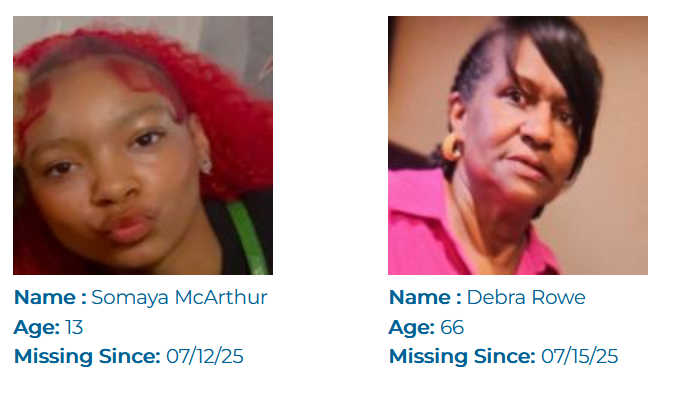
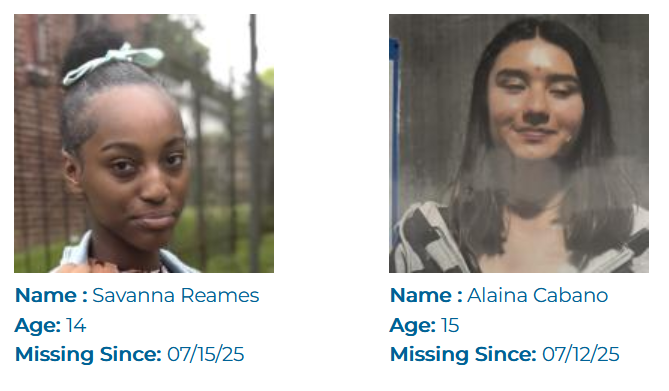
According to the DC Metropolitan Police, in this year 2025, 1,387 people have been reported missing. They have closed the overwhelming majority of the cases, but it is not immediately clear from the website how these cases were closed. There are 37 open cases, 28 of which began in 2025. Here are the four women and girls who have gone missing in the past week: 


Many will remember the horrifying, and still open case, of 8-year-old Relisha T. Rudd, who went missing from a shelter. There are also many men and boys who are missing, just not in the past week. 

For me as a human being and as a sociologist, I sense the difference between looking at the website homepage, which assures the reader that 99% of the cases are closed, and talking with someone who is realizing that their son may be in terrible trouble danger, life-threatening trouble danger [updated with more exact word]. But even the words I am using are inadequate and distorting: trouble suggests the son might have done something to be "in trouble," or people "went missing" or "are missing persons" when in fact they may have been kidnapped, abducted, coerced, taken advantage of, killed, and so on, or may have sought to escape abuse, bullying, and extreme poverty to go on their own. Even those in closed cases may have experienced any one of these. Or they may have experienced something altogether different. 

The sociological literature on missing persons explores several kinds categories of missing persons: 

  • Those missing and dead during transnational migration (for example, those migrating from Central America).
  • Those missing and dead during war (as in Bosnia).
  • Political disappearances (like in Chile or Argentina).
  • We might also add another potential category: those disappeared after migration (by immigration or related officials/militias).  
  • Those missing due to social and economic disadvantage.  

In the Canadian Journal of Sociology, Laura Kiepal, Peter J. Carrington, and Myrna Dawson demonstrated that: "People occupying the intersections of multiple high risk categories are at particularly high risk of being reported missing. Linking missing persons with the concept of social exclusion shows that social and economic disadvantage can lead directly and indirectly to peoples' disappearances" (abstract). 

I will return to this sociological literature and its relevance to Ward 6 and DC in my next blog post. I so hope that the woman at the bus stop found her son and ate dinner with him. 

Wednesday, July 9, 2025

Smartphone-Free in Ward 6

For the month of July, I'm part of a formal group not using their smart phones. The group gave us each a flip phone, which we can use to call and text. Also we can use our other devices in whatever way we want during this month. Right now I'm on Zoom with my writing group, paying attention to emails, and writing this blog post. Each week we meet in person and do various activities. I can say that one week in this experience is so wonderful and deeply meaningful. 

As a sociologist in Ward 6, I notice a few things. First, I am in my mid-50s and I am pretty certain I'm the oldest person in the group. Many of the participants seem to be in their 20s and 30s. There is so much that could be said about this, but I am going to continue to other things. 

Second, the formal group encourages us to make the world around us as addictive as our phones were: building new social relationships and community, reclaiming phone-free space in our minds and in our locality, and importantly learning more about DC. While I like turning to locality myself, as a sociologist of globalization, I know that the phone-free movement is global and has been for several years. There is the bipartisan Phone-Free School Movement (called the Smartphone Free Childhood movement in the UK), which likely exists in every country in some way. People go to phone-free tourist locations and with phone-free travel groups. There are phone-free bars. Reddit has a variety of groups, such as r/dumbphones and r/nosurf. This is a global movement to create other pathways and other ways of interacting outside corporate-Smartphone worlds. How might we remember the globalness we had back in the 1980s and early 1990s (and much earlier too) before cell phones (see my discussion about DC here)

Third, so many people say that AI is inevitable and the expansion of Smartphones use is inevitable. Sociologists really get upset when people say something is inevitable. People make things seem inevitable or commonsense or natural. Sociologists also get interested when people say something is inevitable because this phenomenon and the social investment in it are then in fact fascinating and worth investigating and thinking about. And as I said above, there are global movements making other worlds. 

Just my first sociological thoughts on this from Ward 6.  

Wednesday, March 12, 2025

Updates

Greetings, I just wanted to announce that I made some updates to my blog and will continue to make new updates and postings! 

Thursday, February 13, 2025

New DC Archives Finding Aids!

I just found out that the DC Archives now has online finding aids and online collections. This is really exciting. 

I've been searching for ANC 6B records! City Council records! And so much more!

Tuesday, August 23, 2022

Revisiting "George Washington (Hanadagá•yas) slept here"

Across the landscape, there are claims that George Washington slept here or visited. For example, at Friendship House (also known as Duncanson House and the Maples) on Capitol Hill, he was supposed to have been a guest. In 1940, the Daughters of the American Revolution (DAR) installed a sign on the building stating that, yes, George Washington was a guest here. People have questioned the veracity of such claims, but really why make these claims at all? To start, it seems as if these are claims to significance or value; this building and the homeowners are worthy because they are linked to George Washington. 

A new fascinating article on George Washington by Janine Yorimoto Boldt just came out in American Art, "The Portrait of Hanadagá•yas; or, George Washington Reconsidered," which provides insight into my question. In the article, Boldt discusses the first portrait of George Washington in 1772 as a celebration of militaristic white nationalism and later linked to the Lost Cause. The landscape in the portrait is the Ohio River Valley, where, according to Boldt, Washington said that the Seneca leader Tancharison named him, Caunotaucarius (in English) or Hanadagá•yas (in the language of the Haudenosaunee), "the Town-taker" or "the Town-Destroyer." Other Native American groups referred to him this way, and he called himself this name when communicating with them. Charles Cooke (Thawennensere) translated Hanadagá•yas as: 

"He bites villages"..."A sacker of villages"; a destroyer of towns, a ravager of communities; a plunderer and pillager of encampments...Hyperbolically this verb denotes to destroy, to sack, to plunder, to pillage, to devastate, to demolish, to ravage, to cause havoc, to eat in secret the provisions and crops of others. It is used only in instances of savagery and discomfort. (Boldt 2022: 6)

So, what is the significance of Hanadagá•yas, the Town-taker or the Town-destroyer, visiting Friendship House on Capitol Hill and the DAR putting up a sign about it centuries later? Why the need to claim that he visited?

Could the declaration that Hanadagá•yas was a guest here be a hope by the DAR to take the town of Washington, DC, or ravage communities within it? In 1935, a year before the white segregated Friendship House organization moved into the building soon to have the DAR sign, the director wrote to a government official, "Since your visit here the other evening I have been thinking a good deal about our problem at Friendship House due to the increasing number of [African Americans] in our immediate community. I also have been thinking of the possibility of developing a housing scheme for white people...I believe it would change the character of quite a bit of the surrounding area" (NARA, RG 302 Records of National Capital Housing Authority, Box 4, Letter from Lydia Burklin, Friendship House, to John Ihlder, Aug. 16, 1935). In 1940, the DAR placed the sign on the recently renovated Friendship House. At the same time, this housing scheme displaced about 146 African American households and built the white segregated Ellen Wilson Dwellings in their place. This housing scheme also bolstered other work to expand white segregated areas on Capitol Hill. 

By making claims that George Washington slept or visited here, people bring Hanadagá•yas, George Washington, the Town-destroyer and Town-taker to life. Hanadagá•yas helps them realize their racist urban visitions. Maybe there is a kind of terror that should be recognized in Hanadagá•yas sleeping or visiting anywhere?

Sunday, January 30, 2022

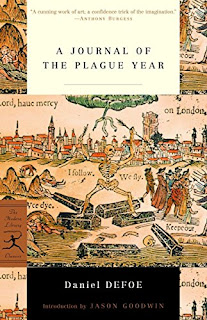
What is Psychogeography? A Journal of the Plague Year

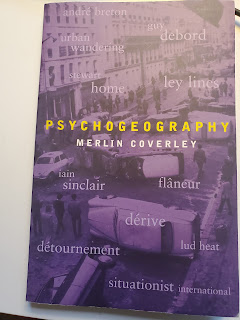
According to Merlin Coverley, the first psychogeographic survey of London was Daniel Defoe's A Journal of the Plague Year. The book, in his telling, is "an imaginative reworking of the city in which the familiar layout of the city is shown to be transformed" (Coverley, p. 37). I dove into the novel without much knowledge about it. It is a completely fascinating book that, in my opinion, is in no way a psychogeography. 

Basically, the book is a fictional story of a saddle maker, who decides to remain in London during the plague of 1665. Defoe published the book in 1722, basing it on his childhood memories, statistical data, and many works that had already been published. In a very journalistic style, the saddle maker talks about what life is like being isolated and about the city when he often goes out around town, which is very life threatening. All those who can have left for the countryside. He has to stay because of his business, and he doesn't have adequate funds to leave town. He reports on conversations and stories, and on people screaming in pain, people wailing in grief from the discovery that their family members were ill or had passed away, people trying to continue to work, people escaping London to live in the forest, and so on. During his relatively short complete isolation, the saddle maker's friend, a doctor, came over, and, like everyone today, the saddle maker was so glad to talk with his friend. Importantly, I started reading a version of the book, which had been rewritten in language of today, which was very easy to read. I also read another version with language of the time, which took some getting used to reading. The whole book is just so interesting about what life was like at that time. I highly recommend it. 

Now, I don't think that the book is psychogeography. He talks about London, but it seems like a newspaper reporter going out and talking about all the crazy things he sees. Here is my earlier discussion of psychogeography, which, in my opinion, doesn't include this (great) book.

Sunday, January 9, 2022

What is Psychogeography? Rorschach Theater

I have had a very enjoyable time doing the first two boxes of "Chemical Exile," the psychogeographical theater piece by the Rorschach Theater. Each of the seven boxes directs you to a specific location and provide you photos, letters, objects, etc. as a chapter in the "Chemical Exile" storyline. The theater's definition of psychogeography is:

It’s the intersection of psychology and geography and while the idea existed long before him, the term was coined by philosopher Guy Debord in the 1950s as an instruction for urban exploration.

A GREAT PSYCHOGEOGRAPHIC EXPLORATION includes these key elements:

  • WANDERING as you explore your physical world in a leisurely way
  • SUBVERTING your everyday relationship with the city through a fresh perspective
  • DISCOVERING the present through the prism of the past
  • ...and maybe a dash of the occult

As a sociologist, I tend more towards the understanding psychogeography as a method of urban exploration, but the theater is working within the literary tradition of psychogeography, which Merlin Coverley's Psychogeography fascinatingly and convincingly argues is even more important. 

Regarding the theater's definition, the wandering is different from drifting because we "audience members" are directed to a location and are exploring the psychological and geographical experiences of the main character. Of course, our own experiences of the spaces are interwoven and are encouraged in the call to be leisurely. 

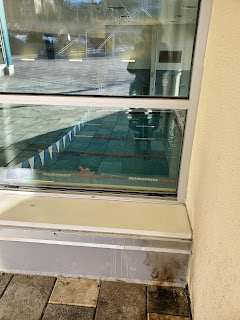
People swimming in Marie Reed pool
Regarding subverting my everyday relationship with the city, I greatly appreciated going to a new part of Adams Morgan. Seeing the pool (see left image), the mural (see image below), and the wonderful picnic tables at Marie Reed Rec Center, as well as other very cool destinations, made the city even more marvelous! These destination also made me re-discover the present through the past. As Coverley writes, "the topography of the city is refashioned through the imaginative force of the writer [or the theater]...a kind of historical consciousness that exposes the psychic connectivity of landscapes" (p. 16). This was definitely the case. 

The occult also appeared! This play is in some sense about the city changing in confusing ways. In the midst of Box 2, which is very much about this, I ended up walking behind three men. I met one of them, Jerome, who was just explaining to his friends how different the area was from when he was growing up and pointing out the new buildings all around. I feel as if these kinds of woo-woo synchronicities are an important element of psychogeography. They highlight or emphasize a point or a significance in the space.

The theater piece sent me walking in new directions, which I am very grateful about. Among other things, I saw a strange portico on the side of a row house near 16th and Florida St, NW, (see below, any ideas about that??), and a kind of informal gallery or political statement near Ontario and Kalorama (see below). On the side of a garage planned to be razed was a series of photos of houses on the 1700-block of Seaton Place/Street, NW. In Shirikiana Aina's movie "Brick by Brick," the fight by the residents of this block to stop eviction as a result of gentrification is documented (here is more information, saying they were one of the first groups to use the new TOPA rules).

"Chemical Exile" is a great psychogeographical experience so far!


Portico


Saturday, January 8, 2022

What is Psychogeography? Drifting

As discussed in my previous post, one psychogeographical method is aimless strolling and drifting through the city. First, French situationalist Guy Debord understood this drifting as a way investigate the emotional terrain of the city. Everyone senses the mood or ambiance of different parts of town. Here Debord suggests that we systematically explore the "zones of distinct psychic atmospheres," their currents, and their edges, as a way to understand the city in a deeper way (Coverley's Psychogeography, pp. 81-103). 

Second, these strolls might move in a more sociological direction, as a way to detect multiple social worlds crossing through the city. Sociologist Ruth Glass understood London as an often invisible constellation of many unfamiliar worlds:

We can see them in the mean streets, in luxury flats, along the roads of suburban ribbon development; in places like Eel Pie Island, where various cliques of teenagers congregate; in jazz clubs, coffee bars, Soho joints, and expense account restaurants; in the withdrawing rooms of earnest religious or political sects; at Speakers’ Corner in Hyde Park or the Earls Court Road; at meetings in Trafalgar Square; in public libraries, senior common rooms, and at soirées of the Royal Society. We get an inkling of the existence of other remote and yet nearby worlds through migration statistics; through fascist news-sheets and...scrawls on the walls of back alleys; through unsavoury court cases or complaints before rent tribunals; in reading Press items about witch rites, ghost hunts, visits from Martians, and take-over bids. And then again, we may hear of the ‘hidden’ societies through reports of hospital almoners [officials who determine if someone qualifies for assistance], N.S.P.C.C. [National Society for the Prevention of Cruelty to Children] inspectors, or social workers who bring ‘meals on wheels’ to lonely old people. It is an amazing, still largely obscured, panorama that thus begins to be visible— a conglomeration of groups who move, so to speak, on separate tracks, even if they do meet occasionally at a station. (Glass, introduction to London: Aspects of Change, 1964)

Aimless strolling (and other methods) builds on our already existing human abilities to pick up on this panorama of social worlds and expand our understanding of cities beyond mass media and real estate's simultaneous "cliches of urban doom" (Glass 1989) and celebration of, what she termed, "gentrification" (Glass 1964). 

Third, drifting also accesses our unconscious/subconscious and its amorphous knowledge of the city, which might also be considered a psychogeographical method. Back in September, I did a drift through Georgetown. I was born in Columbia Hospital for Women, and my family during my first year of life lived in a basement apartment in a Georgetown rowhouse around 27th and P Street, NW. So, I started on that block and drifted with the idea that my unconscious/subconscious might have retained knowledge of that time or might be open to knowledge embedded in the geography. Animals defined the drift. After being accompanied by crows flying overhead, I found myself in Mount Zion Cemetery/Female Union Band Society Cemetery, where I spent some time. Walking around Dumbarton House (the national headquarters of The National Society of The Colonial Dames of America) and along Oak Hill Cemetery, I didn't feel like going into this cemetery, but I did and followed a cardinal to two headstones with family names -- Boswell and Merrick -- related to my Capitol Hill research. I believe that I walked down 29th St. On tiny Cambridge St, which made me think of Cambridge, MD, and Harriet Tubman (though maybe not the intention of the street name), I encountered a small rabbit on someone's side lawn. I returned to 29th on Dent St, possibly named after the large-scale enslavers from Charles County, MD. Paying attention to people and further animals, I mysteriously found myself again at Mount Zion Cemetery/Female Union Band Society Cemetery with at least one hawk flying overhead. And I walked down the hill to the Rock Creek path below. I found the aimless strolling very interesting. Obviously, my drift picked up on certain historical connections in the geography, while others would likely have a very different drift. To try to make sense of the drift, I took notes immediately, described the entire drift on paper soon afterwards, and drew a map.

I'm soon going to experience the Rorschach Theater psychogeography, which, of course, begins in Mount Zion Cemetery/Female Union Band Cemetery...

Saturday, January 1, 2022

What is Psychogeography?

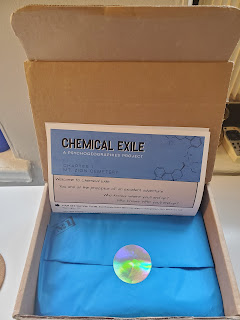
For some time, I've been intrigued by psychogeography. A couple of weeks ago, I received a letter from the Rorschach Theater on H St, NE, saying that they had been doing some psychogeography theater. I signed up (and paid) to figure out what they are up to and just received in the mail this box as part of a series of boxes: 

I haven't yet experienced this project, but I wanted to explain why I find psychogeography interesting (and certain practices problematic), which is based completely on a very useful book, Merlin Coverley's Psychogeography:

1) Psychogeography generally involves walking in a city.

2) Psychogeography is a method of exploring cities in new ways. For example, one might take a drinking glass and draw a circle around its base on a city map and then follow, as best one can, the circle through the city. One could also throw dice to make walking decisions. Alternatively, one can take "a drift," in which one follows one's subconscious to figure out new connections, places, "zones of distinct psychic atmospheres," etc.

3) Psychogeography is a perspective that views the city as a mystery, which requires secret knowledge to understand. On the one hand, one might follow Peter Ackroyd and see the city as having an ancient, eternal nature understood through hidden signs, codes, etc. On the other hand, one might observe the movements of working class groups through the city as they map their own labyrinthine, secret city (like in Edward P. Jones' Lost in the City). 
 
4)  Psychogeography is a perspective in opposition to the homogeneous city, the city of gentrification and standardization that makes all cities the same, as well as different also in the same ways. This view allows us to sense the marvelous city and how opaque areas of or certain past activities in the city remain around us in a kind of layering, a palimpsest. 
 
5) Psychogeography might be a way to take the city from developers, real estate agents, and others who seek to erase the city, displace the working classes, and create a "Great Blight of Dullness." One might follow Stewart Home and usurp the claims of these real estate actors, leave secret codes for others, and take and transform the city. 
 
6) Psychogeography can be imperialistic. For example, some psychogeography groups call themselves astronauts. If one walks through DC viewing oneself as an astronaut, then one might see other people as foreign beings, potentially dangerous aliens, and definitely not as neighbors or as people with a "right to the city." One can follow other traditions of psychogeography to hopefully avoid this; these traditions are discussed in Merlin Coverley's great book Psychogeography

Friday, October 1, 2021

The Dangers of Settler Colonial Art

This past summer, the Hill Rag informed readers that they could "Volunteer to Restore Mondrian-Style Murals Saturday." The murals are located in the underpass below the Southeast Freeway at 6th Street, SE, and originally joined a 30-foot high mural across the street, on the side of a public housing building in the Ellen Wilson Dwellings (see image). The chair of the ANC 6B had decided to organize the re-painting and restoration of the murals. I am mentioned in the article as providing some basic information about the murals, that they were painted between 1988 and 1992. When I learned about this restoration project, I knew that I had to say something about the history of the murals.

I had done years of research about the person who commissioned the murals, his connection with Piet Mondrian, and the philosophical ideas of Mondrian himself. My research article "The Aesthetics of Gentrification: Modern Art, Settler Colonialism, and Anti-Colonialism in Washington, DC" came out in August, just as the group was finishing the restoration, and you can read my article here or access it on my faculty webpage. The international urban journal that published my article tweeted this about it: 

argues that The Mondrian Gate—series of murals on/near a public housing project in Washington DC just before its demolition— enabled Black erasure, dispersal, dispossession, and displacement bit.ly/3Czrh3b

Yes, the murals enabled the permanent displacement of hundreds of African American residents of the Ellen Wilson Dwellings. My article is a scholarly article and difficult to read, but this is because I am forging new historical knowledge based on a wide range of archival sources. The article is worth reading, especially because it has some amazing pictures and it explores DC and Capitol Hill history in the late 1980s and early 1990s. I also seek to understand what Mondrian sought to do in his art and what it meant for the city:

Mondrian’s artworks were cartographical fantasies of a vast, segregated, white European city pushing colonial subjects to marginalized areas, and the destruction this would necessitate. [See the many white boxes at the center of the image above crowding out the colored boxes at the edges of the painting.] The late 1980s and 1990s opened up possibilities for new forms of displacement and revanchism on a global scale. [The commissioner of the murals] Robbins brought Mondrian’s maps of a future segregated, imperial world to 1980s Washington, DC. Within this revanchist context, Robbins used the Mondrian images as a fortress gate, a racial map of the future, and as a gallery for public education...The Mondrian Gate signaled both the defense of Capitol Hill and its purification as a space of pure white, pure black lines and distant pure colors, and also motivated a white empowerment to take new land––a settler colonial globalization.

There are many criticisms of the corporate uses of counter-cultural murals. These murals were in no way counter-cultural. The commissioner of these murals planted a settler colonial flag at what was considered the southern edge of Capitol Hill as a statement about the future of this part of DC. 

Is the desire to repaint the murals some kind of expression of the settler colonial subconscious? Complicity with colonialism? Maybe the murals should have been left alone or even painted over? Or maybe another kind of mural should have been put in its place? Maybe the one in front of the Ellen Wilson Community Center (see it in the article)? What kind of murals would you want to have there?

Wednesday, May 19, 2021

The Spiritual Destruction of Gentrification

Yesterday I was reading the oral history of John Harrod, who directed the Market 5 Gallery, a community art space in the North Hall of Eastern Market, from 1973 to 2009-2010 or so. Market 5 has a fascinating history. In 2007, there was a huge fire in Eastern Market, but Market 5 amazingly avoided the fire, in part due to an effective firewall between the North and South Halls. But other forces may have also provided assistance...

Market 5 organized the weekend markets and vendors at Eastern Market. Among the vendors are psychics. The oral history has two very interesting segments regarding the psychics:

LEWIS: So, the psychics claim they stopped the fire?
HARROD: Because of their power, the fire didn’t come into the North Hall! [laughs] (p. 30)

HARROD: Have you ever been there and looked up in the ceiling, the trusses in the ceiling?
LEWIS: Uh huh.
HARROD: The psychics tell me that there’s a pyramid shape that’s up there.
LEWIS: Oh really?
HARROD: Yeah. Which means that the Gallery is protected by, according to them, the strength of the pyramid—a sign that is found so many places in nature. Did you know that?
LEWIS: Exactly. (p. 36)
According to this view, the psychics and symbols protected the space. As is clear from many documents, Market 5 had a spiritual presence and energy. As I will discuss in future posts, the Capitol Hill/Southeast area has had a vast landscape of spiritualities protecting spaces and people. 

However, gentrifying forces use disasters and shock to displace obstacles in their way, even those with protection. Often, such obstacles are completely destroyed and the space left vacant in an attempt, it seems, to destroy and erase the spirits. Also gentrifying forces may take advantage of chaos without plans for the space. Even though it escaped the fire's physical destruction, Market 5 Gallery was evicted and never allowed to return. Gentrifying forces took advantage of the fire to evict Market 5 and replace it with a homogeneous, predictable, almost empty space, a space without spirit. Here is Market 5 Gallery from a video in 2008 as they are being moved out:

Market 5 Gallery in 2008, https://www.youtube.com/watch?v=PPwmVLm2CGg

Here is the same space today (my photos taken this morning):


Still a pretty space, but Market 5 was erased and replaced with a spiritually empty space. A space ready for whom or for what?

Wednesday, May 12, 2021

Public Housing Reunions

Today I came across an article by several amazing sociologists -- Marcus Anthony Hunter, Mary Pattillo, and Zandria F. Robinson (Georgetown!)-- and the brilliant Keeanga-Yamahtta Taylor, which really captured what is going on in Ward 6 in DC. In this article "Black Placemaking: Celebration, Play, and Poetry," they explore the ways that African Americans in Chicago have made meaningful, creative, celebratory, playful, pleasurable, and poetic experiences in hostile places. The authors focus on four case studies: black public housing reunions, black lesbian and gay nightlife, black Little League baseball, and the black digital commons. 

Ward 6 is filled with similar cases. Arthur Capper Recreation Center hosted a wide range of sports, including the Washington Stonewall football team, as well as a wide-range of other teams that competed throughout the city. Towards the end of 8th Street, SE, Bachelor's Mill, Back Door Pub, Phase 1, and many other locales continued a vibrant black lesbian and gay nightlife in the area. What especially resonated with me was their discussion of public housing reunions (pp. 39-43)!

Even though the buildings were destroyed by the DC government with federal support, the former residents of Arthur Capper public housing remain a community and have regular reunions. As in Chicago, the Arthur Capper community has a Facebook group with 1,400 members. Other public housing projects also do this, both those projects that are now gone like the Eastgate Gardens (their Facebook group has 2,100 members) and those current public housing projects like Potomac Gardens and James Creek. In Chicago, as discussed in the article, former public housing residents celebrate annually at the site of the former projects or at parks nearby or elsewhere in the city. The Arthur Capper community has held annual reunions in nearby Garfield Park and other parks in the DMV. The wonderful Sherman Mills invited me to the annual reunions. I wrote about one several years ago (here), and Sherman Mills and I put together a special website about the Arthur Capper community. The "In Loving Memory" section is particularly insightful with its photos and names of those who have passed. 

The authors of the article about Chicago explore the living communities of current and former public housing residents. The authors write:

At the height of their occupancy in the 1970s, Chicago’s family public housing was officially home to over 137,000 people, most of them African American (Hunt, 2009: Table 1). The actual number might have been up to 40 percent higher than that (Venkatesh and Çelimli, 2004: 28). In 2012,the population in family public housing in Chicago was just over 23,000 (Chicago Housing Authority, 2012: Appendix 2). Despite this drastic population loss, the disappearing of black public housing residents was unsuccessful. Even the children of former residents proclaim their public housing lineage: ‘Me & my pops at the Robert Taylor Homes reunion/ he grew up in building #4101/had to capture that’, writes one young woman about a photo of her and her father in front of a mural of her father’s building and the title ‘Robert Taylor Family Reunion.’
The authors further reflect, "As long as these memories are rehearsed, shared, spoken, and envisioned then the projects and the black families and communities that they housed will not die." Do members of the Arthur Capper community agree ? How do these and other displaced communities continue to live in DC and what does this mean for DC?

Monday, March 22, 2021

Gentrification in Capitol East

On April 3, 1975, Gilda Warnick, Rosetta Byrd, and Marianne Josem of the Capitol East Housing Coalition testified in front of the DC Council about how housing speculation was affecting them and the Capitol East area (here pp. 584-598). They and others had formed the Capitol East Housing Coalition a year earlier to stop the displacement of long-time low and moderate income residents. This displacement was caused by real estate speculation. In Capitol East, tenants were having their homes bought from under them and received eviction notices. Here are some excerpts I found most eye-opening:

Ms. Warnick:...We have found that the number of persons speculating in Capitol East is alarming. Last year, we found that over 60 investment groups, individuals, partnerships, and corporations operate in Capitol East, and since then, the list has grown dramatically

...speculators also benefit from more concealed and hidden real estate practices, such as flipping. Flipping is a process of buying and selling contracts before the property goes to settlement, and in this way, properties are artificially inflated before they enter the real estate market. Several real estate operators have told us about this practice, but it is extremely difficult to document, because the transaction does not appear in official records. 

Another practice is use of straw parties and dummy corporations, which gives speculators anonymity, while assembling real estate and ways of evading taxes. It also makes it difficult to get at the root of the speculation problem, which is the financing...

Those residents I am talking about are people who have literally already bought their homes. They have lived in there 12 or 15 years paying rent. They never had enough money to save up for a down payment or settlement costs. Then when the house is sold, they are given a month's notice to move, having had no time at all to try to purchase a home...

Linden Place NE

Ms. Byrd: My name is Rosetta Byrd, and I am the block captain of Linden Place, Northeast [between 12th and 13th St, south of H St NE]. I came here to tell you today about a housing problem myself and my friends are having because of real estate speculation on our block....Most of us have lived here for many years. We are regarded as low and moderate incomes, and many of us rent. All of a sudden last year, Linden Place became a speculator's market. Sixteen homes were bought up by them west of the park, from Virginia and Maryland. Six of them were bought by Capitol Hill real estate agents...Because of these problems, we on Linden Place decided to organize a block club to help each other to stay in our homes... 

To stop this displacement and "the cancer spreading all over the city," they asked the DC Council to:

  • Give tenants the first opportunity to buy the properties. 
    • With the assistance of "a citywide revolving loan fund, which could be financed from the sale of bonds, and the revenue from the sale of bonds, and the revenue from the passage of taxes on tangible property and professional services."
  • Implement a speculation tax.

The DC Council realized their request with a speculation tax in 1978 and Tenant Opportunity to Purchase (TOPA) in 1980. We know from Katie Wells' work that the the speculation tax was quickly overturned. In the meantime, Rosetta Byrd appeared on a 1978 news segment "Disappearing People," in which "Rosetta Byrd describes her experiences after being evicted and moving from place to place looking for low-income housing she could afford." 

How might we use policies like these (as well as protecting public housing) to help low and moderate income residents stay in DC?

Tuesday, September 29, 2020

The world-building of Ms. Comey's granddaughter

 Yesterday, I read a very interesting book review by Petal Samuel in Public Books, one of my favorite sites for reviews of academic books. Professor Samuel is a brilliant scholar in the Department of African, African American and Diaspora Studies at the University of North Carolina-Chapel Hill. She reviewed two books that explore speculative fiction and fugitive science. Her discussion of one of the books -- Sami Schalk’s Bodyminds Reimagined: (Dis)ability, Race, and Gender in Black Women’s Speculative Fiction -- particularly resonated with some recent, local events:

[In Phyllis Alesia Perry’s Stigmata, a novel Schalk analyzes], Perry’s black woman protagonist, Lizzie, is misdiagnosed, institutionalized, and inappropriately medicated because she shares her consciousness with her ancestors. Mental instability is attributed to those who resist white supremacist order and deployed as a way to discredit marginalized perspectives. Put simply, Schalk writes, “race and gender are important factors in who gets labeled mentally disabled and how a person is treated as a result of such a label.”

On Saturday, my partner and I were talking with a neighbor, when I heard someone nearby sobbing. It was the granddaughter of Ms. Melissa Comey [sp?], who had owned the house and Comey Hair Salon near 10th and C Streets, SE. Ms. Comey's granddaughter was reliving her life at that house and the loss of the Comey family home, the dispersal of her family members and community, which were, in her words, "all gone." The sobbing woman's grandmother had sold the house several years ago and her family was forced to leave, but her granddaughter had not abandoned her connections with the neighborhood that gentrification had forced her to leave. She explained that sometimes she forgets that she isn't living anymore in that time or this place. She shared stories with us about playing hopscotch on the sidewalk and parts of the life she lived here. Then she turned the corner and disappeared. To me, her arrival was a gift or maybe a very important message from the past about a different potential future.

A few minutes later, some people involved with helping the homeless approached us to ask where they could find Ms. Comey's granddaughter. They had their own perspective on the situation. They could only see Ms. Comey's granddaughter's sharing of "her consciousness with her ancestors" as mental illness. They wanted to arrange a quick intervention by mental health professionals. They deployed mental illness, in a way Schalk described: "as a way to discredit marginalized perspectives" like hers. 

Whatever mental illness she suffered, Ms. Melissa Comey's granddaughter also showed what Samuel called, "modes of black innovation, creativity, and improvisation in the face of ongoing social, economic, and intellectual oppression" and white supremacist order. She was able to envision and live within another world in which she or her family and neighbors still lived at 10th and C Streets, SE, a world in which she still had a home that her neighbors recognized, a world in which she was not classified as "homeless" and as "mentally ill." Ms. Comey's granddaughter and the many people like her, including the authors of speculative fiction that Samuel discuses, demonstrate "the capacity of black speculation and experimentation to generate world-building visions that are inclusive and sustainable for multiply marginalized black subjects." How many worlds and futures exist or are emerging around us? Are we hearing them or silencing them? Could we step into these worlds we are invited to view and take off into another future?


Friday, March 20, 2020

The Shared Inequalities of DC and Puerto Rico

Back in 2011, I visited Brazil, which was so wonderful and interesting. In a blog post at that time, I looked at its notoriously high Gini index (a conventional measure of income inequality) and compared it with the Gini index of DC and Puerto Rico. According to the Census, “The Gini index varies from 0 to 1, with a 0 indicating perfect equality, where there is a proportional distribution of income. A Gini index of 1 indicates perfect inequality, where one household has all the income.” According to the latest data in 2011 (2009 Census data), DC and Puerto Rico have long had the highest Gini indexes of the entire United States and had similar levels to Brazil.
Last weekend, I visited Puerto Rico, which was so wonderful and interesting. Today I decided to revisit my comparison:

1960
1979
1989
1999
2004
2006
2009
2015
2016
2018
DC Gini

.450
.492
.549

.532

Puerto Rico Gini


Brazil Gini

[.61]

.513
.537

(I need to fix this table. The years go from 1960 to 2018.) As before, DC and Puerto Rico share exactly the same Gini index, which was .532 (2009 data) and most recently is .542 (2016 data), and which is now above Brazil’s Gini index. You can see that these numbers are very high in the World Bank’s listing of Gini indexes for countries worldwide here. Of course, there are issues with comparing countries, states, and cities, as well as the problems with using measures of income inequality in place of other kinds of inequality. Leaving those aside, what could explain these similar Gini indexes?

Back in 2011, I hypothesized that these high levels of inequality may be due to the fact that both DC and Puerto Rico lack representation in Congress and lack democratic control over parts of their governments. Furthermore, in 1995-2001, DC was subject to Financial Control Board (see its 1995 law here). During this time, there was a large jump in DC’s Gini index from .492 to .549. In 2016, Puerto Rico is now subject to its own financial control board (see its 2016 law here) and may experience similar increases in inequality.

In 1989, when Brazil had reached its highest Gini coefficient level, the Brazilian people freely elected their first president after decades of military dictatorship. After 1989, Brazil’s Gini coefficient declined significantly through the reduction of poverty. According to a 2017 IMF working paper, Brazil’s “Inequality reduction was achieved thanks to a decade-long period of economic growth and deliberate income and social inclusion policies, such as minimum wage increases and targeted social programs.” Could lack of full democratic representation have an impact on inequality?